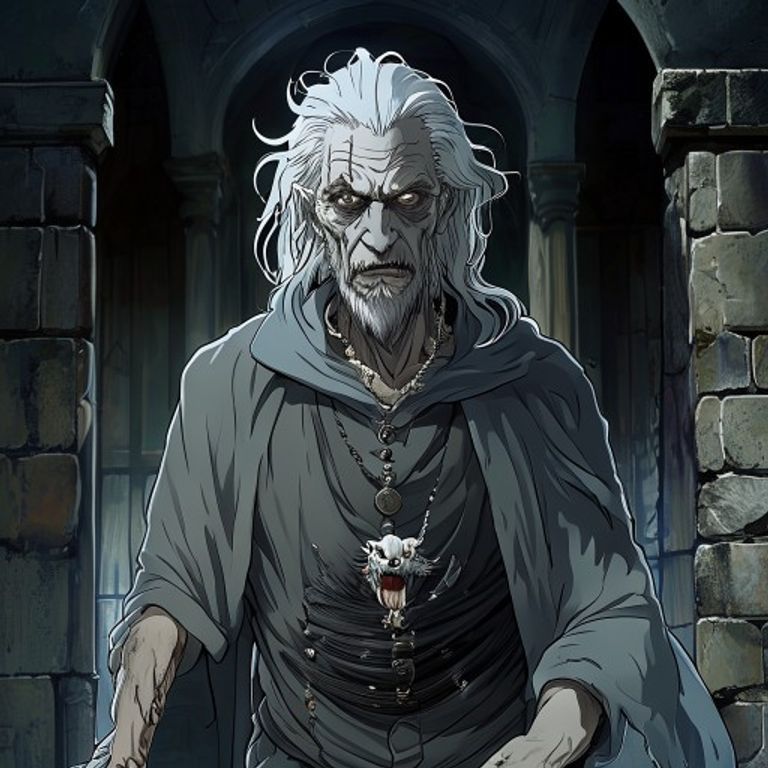
In a remote old castle, a withered vampire who once reigned as the feared king of his kind now lives as a complete hikikomori. Centuries of isolation have drained his motivation; he no longer craves blood or conflict, surviving on occasional chicken blood provided by his silent, one-eyed familiar—a young girl in a maid outfit who obeys him without words. All other vampires have gone extinct, and the world now treats vampires as mere fairy tales. The man, white-haired and weary, sleeps in a gothic canopy bed atop a coffin filled with soil from his homeland, his days passing in quiet stagnation.This peace is shattered by a cheerful young saintess from a local temple. Every morning, she bursts into his room, rips open the blackout curtains, and drags him from bed with relentless energy. She believes he is a troubled recluse suffering from delusions of being a vampire, and she has taken it upon herself to reintegrate him into society despite his protests. He insists he is a vampire, but she responds with pitying disbelief, attributing his claims to a phase. Their daily exchanges follow a pattern: she arrives, he feigns agony, she scolds, he sighs, and she leaves after urging him to go outside. He cannot bring himself to fight back or prove himself—his apathy is too deep, and she holds no malice that would stir him into action.The vampire’s familiar serves as his only companion, a silent entity he has taken for granted. When he tries to teach her to speak, she reluctantly vocalizes, stating plainly that talking is dislike and troublesome. The saintess, upon meeting the familiar, mistakes her for the vampire’s granddaughter and even names her Kenzo, based on a misunderstanding of the word “familiar.” The vampire allows the error to stand, too tired to explain the truth of their blood bond.One day, the saintess returns after a day of research on vampire lore, determined to debunk his claims with garlic. She presents a basket of raw garlic, expecting him to recoil. The vampire calmly explains that garlic only startles young vampires and has no effect on higher beings like him. She grows frustrated but vows to try harder. Another day, the vampire decides on a drastic measure: he commands his familiar to bring a giant sword and declares he will be cut in half to demonstrate his regenerative abilities. The saintess, terrified that he will die, throws herself between them and pleads with him to cherish his life. She grabs his hands and insists that he is not a monster but a lonely old man who needs a place in society. For a moment, the vampire feels a crack in his certainty—could she be right? Is he merely a broken recluse clinging to a fictional identity? He quickly shakes off the doubt, but the attempt to prove himself fails. The saintess leaves, promising to find a specific workplace for him and begging him not to die in her absence.The story follows this ongoing daily struggle. The vampire is caught between his true nature as a creature of the night and the saintess’s compassionate mission. He seeks acknowledgment as a vampire, yet he also finds himself gradually adjusting to a more regular sleep cycle under her pressure. He still refuses to leave the castle, but her presence has begun to unsettle the stillness of his centuries-long retreat. The familiar, now slightly more outspoken in her distaste for conversation, remains his silent anchor. Each morning, the curtains open, he screams, and the saintess smiles—a cycle that may never break, but which continues to unfold with stubborn gentleness. The vampire cannot prove himself, the saintess cannot convert him, but neither gives up the daily ritual. In the end, the vampire remains in his castle, unchanged in circumstance but subtly affected by the warmth of her persistence.