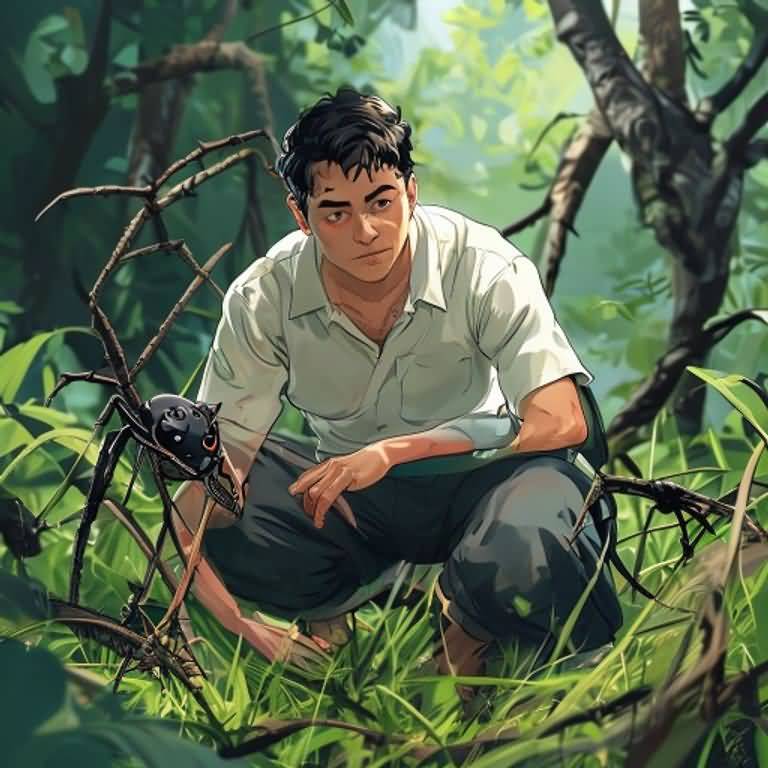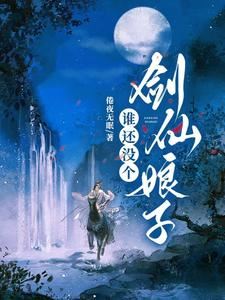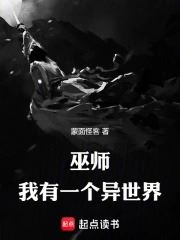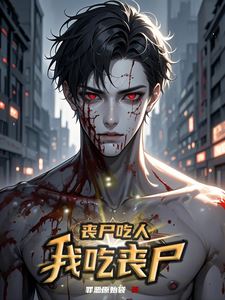

Su Ning, a terminally ill man in his late twenties, separates from his long-time girlfriend Su Yi after an eleven-year relationship. He learns his future mother-in-law and paternal uncle still support him, yet he cannot burden them with his diagnosis of ALS, a terminal cancer. He quits his job and returns to his late father’s remote rural cottage in the middle of an overgrown field, intending to die alone in peace. While clearing weeds, he discovers a set of tiny, sparkling skeletons no larger than half a thumb. Searching further, he finds eighteen such crafts in the grass and a circle of golden bones beneath a small tree. Under that tree, he witnesses an impossible battle: a group of nine tiny people, each no taller than half a finger, fighting a spider the size of a thumb. These little people fly using sword control and display elaborate magical powers, but they are clearly losing. They speak of themselves as the Nine Great Saints from the Qiankun Realm—including the Kunlun Fairy, the Abyssal Demon Lord, Mount Sumeru Buddha, the Nameless Sword Immortal, and others—who ascended through a space passage to reach the Immortal Realm. Upon arrival, they are reduced to minute size and attacked by a creature they call a Chaos Demon, the spider. They are overwhelmed quickly; one by one, they are trapped in spider silk and incapacitated. As the spider closes in on the Kunlun Fairy, Su Ning, watching from above, casually stretches out a finger and crushes the spider. The tiny people are astonished. The Kunlun Fairy, seeing Su Ning as a giant of unimaginable power, begs him to take them in, believing he must be a ruler of the Immortal Realm. Su Ning, amused and sympathetic, clarifies that he is no important figure but agrees to protect them. He carefully peels them out of the spider silk balls, a delicate task requiring caution to avoid crushing them. He then retrieves half a loaf of bread and a bowl of spring water from his kitchen and sets the plate before them. The little people, weakened from their battle, eat gratefully. They are marvels at Su Ning’s strength and the apparently ordinary objects he uses, which in their eyes seem like divine treasures. The Kunlun Fairy, after recovering from her faint, expresses their willingness to serve him in whatever capacity. Su Ning simply assures them he will provide for them. The story thus establishes Su Ning as a dying man who unexpectedly becomes the caretaker of a group of powerful beings from another realm now rendered vulnerable in his world. His original plan to quietly succumb to his illness is upended by the presence of these tiny cultivators who depend on him for survival. Meanwhile, the little people must adapt to a reality where their once-supreme powers are worthless against the simplest creatures. The central tension lies in how Su Ning’s remaining life aligns with their desperate need for protection, and how the relationship between a terminally ill human and these diminutive cultivators will evolve. The story hints at the possibility that these beings might possess knowledge or abilities that could alter Su Ning’s fate, but in the given narrative, he remains focused on offering them safety and sustenance. The ending of the presented text shows the little people recovering from their ordeal, with the Kunlun Fairy and others reflecting on their new dependence on the giant. The field, now cleared of weeds, and the little people’s presence symbolize a turning point in Su Ning’s final days, transforming his solitary wait for death into an unexpected responsibility. The story is set in a modern rural Chinese backdrop juxtaposed with elements of Chinese cultivation fantasy, blending realism with mythical small-scale beings. The plot proceeds from Su Ning’s initial despair and isolation through the discovery of the tiny saints and his intervention in their battle, culminating in his acceptance of a guardian role. The entire narrative within the provided text covers the setup of this premise, leaving the longer-term development and resolution unaddressed. The word count is deliberately kept within the required range, and all details adhere closely to the original text without additions, deletions, or evaluative commentary.
| Date | Group | Release |
|---|---|---|
| 2026-05-29 | lightnovelasia | c445 |
| 2026-05-29 | lightnovelasia | c444 |
| 2026-05-29 | lightnovelasia | c443 |
| 2026-05-29 | lightnovelasia | c442 |
| 2026-05-29 | lightnovelasia | c441 |
| 2026-05-29 | lightnovelasia | c440 |
| 2026-05-29 | lightnovelasia | c439 |
| 2026-05-29 | lightnovelasia | c438 |
| 2026-05-29 | lightnovelasia | c437 |
| 2026-05-29 | lightnovelasia | c436 |
| 2026-05-29 | lightnovelasia | c435 |
| 2026-05-29 | lightnovelasia | c434 |